
Book Review: Get Married, Have Babies, Join a Church by Sean DeMars
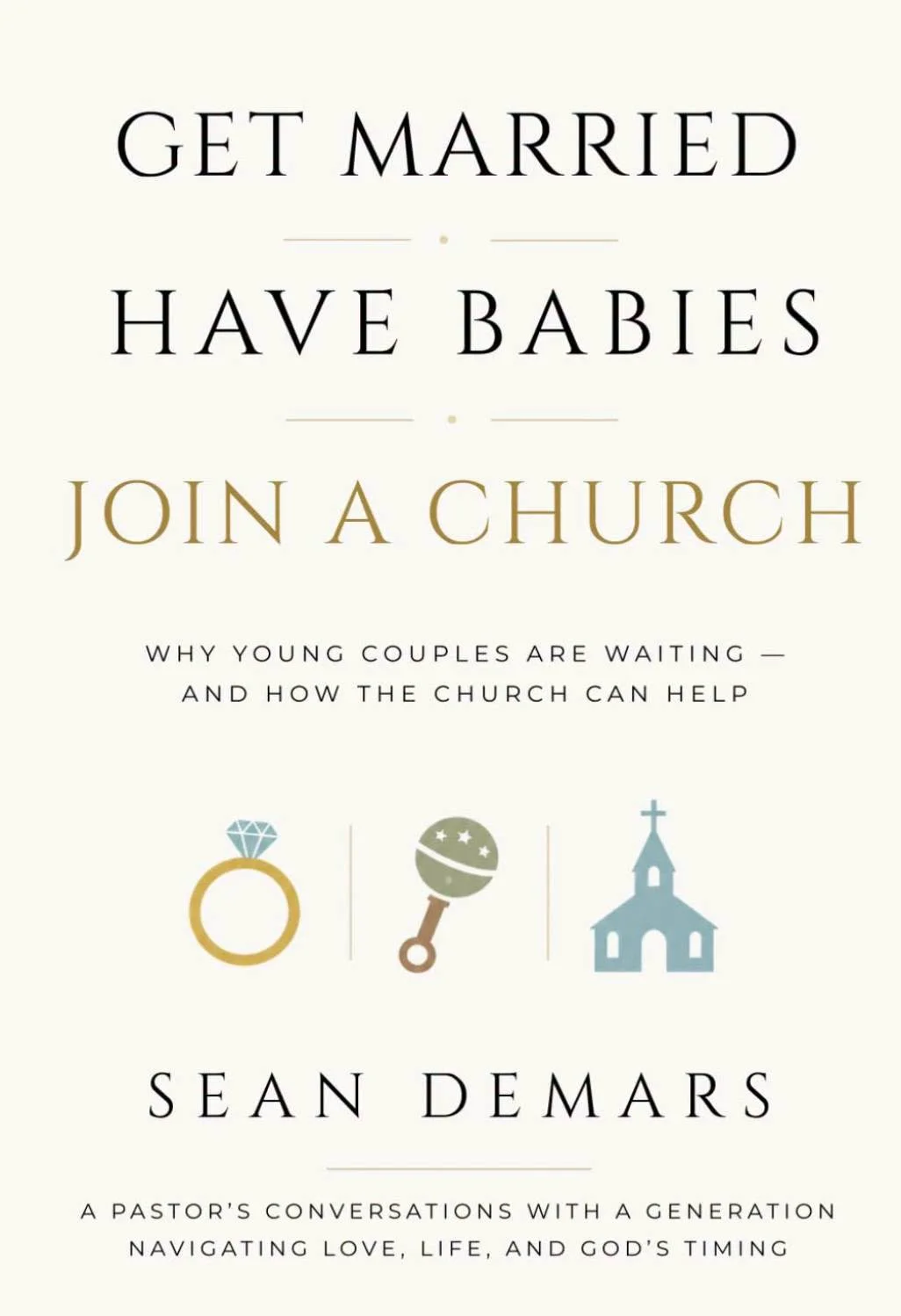
“Get married, have babies, join a church.” In a U.S. culture from fifty years ago, that kind of counsel would have been the no-brainer, common sense provided by a grandparent. But that generation—and the wisdom associated with it—are long gone.
The reasons for this paradigm shift are numerous. But rather than evaluating the causes directly, and only evaluating the problems from a theoretical vantage point, Sean Demars takes up the cause and walks through practical pastoral advice that can help pick up the pieces, in his new book that has that advice as its title: Get Married, Have Babies, Join a Church. In the book, he looks at issues that singles and couples face, covering a host of topics that range from immaturity, to finances, to infertility, to church membership, and beyond. Subtitled, A Pastor's Conversations With a Generation Navigating Love, Life, and God's Timing, DeMars narrates nearly a dozen real conversations that he has (presumably) had with those in his church looking for answers. And while I think there is a necessary time to provide more structured, biblically exegetical instruction on the issues of marriage and family, the casual and conversational style narrated by DeMars in this book is undoubtedly one of its strengths.
About the Book
The impetus for the book can be found in the Introduction:
Something has changed in the way many young people think about adulthood. As a result, more and more are delaying the things previous generations considered normal parts of growing up.
Marriage is delayed.
Children are delayed.
Church commitment is delayed.
Adulthood is delayed.
Of course, there are sometimes good reasons to pump the brakes on major life decisions. This book is not an argument for the young to indulge in the most reckless impulses of their youth. Rather, it’s an argument against the growing assumption that adulthood can only begin after you’ve secured the four C’s: credentials, career, cash, and comfort.
Each chapter essentially opens by setting the scene for the conversation. Some chapters feel almost like the opening to a sitcom (“Tyler arrived at the restaurant a few minutes late…”, p. 14), whereas others provide more character development upfront (“Ashley was the kind of person who made you feel like an underachiever just by being in the same room as you…”, p. 82). From there, the conversation usually begins with a young person or a couple approaching DeMars with an issue
Chapter 5, for example, begins as follows:
Luke and Hannah were back. Married now. Eight months, to be exact. A fact Hannah mentioned with particular pride.
They’d asked to come over for dinner to talk, and somewhere between the salad and the dessert, Luke set down his fork and looked at Hannah nervously. “So,” he said turning to me, “we wanted to ask you something.”
“I’m all ears,” I replied, cutting a quick, knowing glance at my knowing wife.
“We’ve been talking about when to start trying. You know, for kids.”
“I was wondering how long this would take,” I said through a warm smile. “I’m glad you brought it up.”
The chapter then describes the twists and turns of the conversation as the couple expresses their fears about having children. The husband (Luke) was just promoted at work, the wife (Hannah) has a big project at her job, and together they had just bought a house. Beyond that, life was “pretty good” (their words), and they recognize that having a child would change all of those dynamics. DeMars offers probing questions to determine what their overall goal in life is, whether or not there are unspoken selfishness, and how reproductive technology has influenced their choices.
The chapter ends with this:
“I think,” Hannah said slowly, “we came here for permission to wait a little longer. And I think we’re leaving without it.”
“You’re leaving with something better than permission,” I said. “You’re leaving with clarity. What you do with it is between you, Luke, and the Lord. But for what it’s worth, I think you’re going to be a great mom, and I can’t wait to watch you and Luke build your family together.”
An Accessible Resource
Though I may have a few minor theological quibbles with the book here and there, and especially would have preferred to see a stronger emphasis on the authoritative instructions for men and women as found in the pastoral epistles (particularly describing the biblically ordered family in which the husband provides and the wife is a worker at home), I greatly appreciate the direction the book points young people in. And assuming these are accurately transcribed conversations that happened spontaneously and in real-time, any critique of the book I would offer has to be tempered by the fact that pastoral counsel in the moment is a far different exercise than a theological treatise written in a library. For those reasons, I think the book makes for a great on-ramp to people not only looking for answers, but interested to see that they aren’t the only ones asking.
Coming in at only 120 pages, with a conversational tone throughout, the book makes for a low barrier-to-entry for those who might otherwise have hesitations. Accessible. Casual. Readable. These characteristics make the book ready to hand out to the young people in your life who want to begin thinking rightly about their future in a culture that has all but forfeited any such reliability. I enjoyed reading a copy provided by DeMars, and I think others will enjoy it as well. “Get Married, Have Babies, Join a Church” is now no longer just sage advice—it’s a book.